
By Raghad Genina
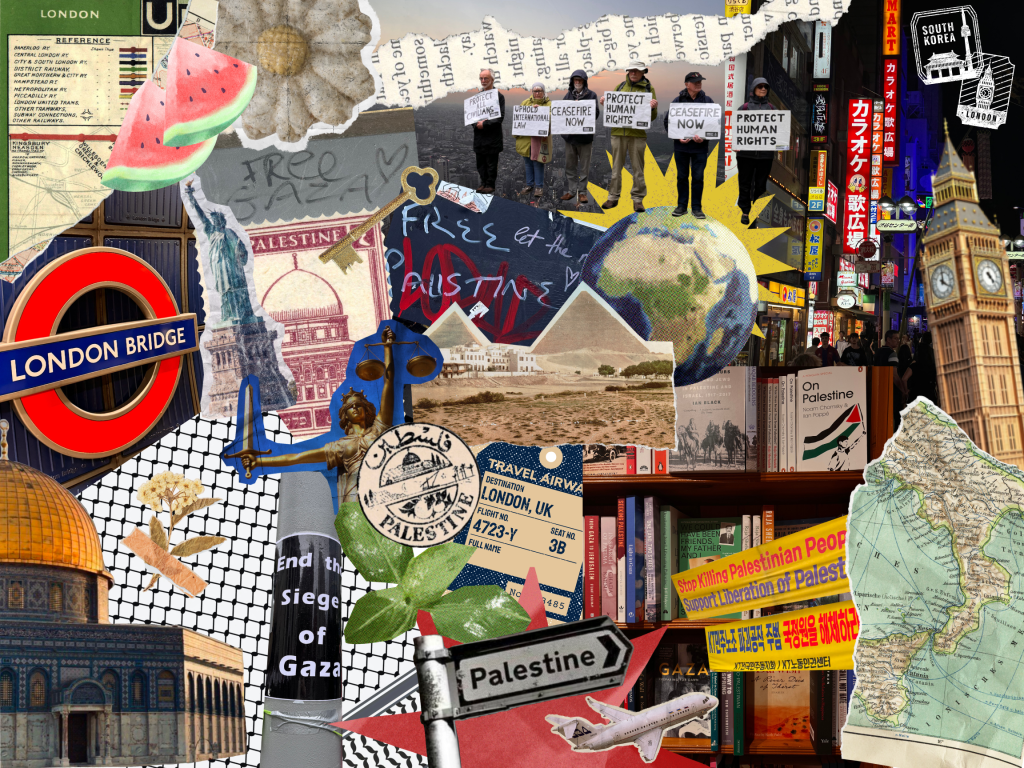
As I walked down Oxford Street in London, “Free Palestine” stickers were plastered on the walls of public spaces, and the words “Free Gaza” were written on different surfaces—the message being impossible to miss. Amidst the crowd of people on the street, a woman stood, tightly holding an umbrella with the question, “Will you free my Palestine?”, a powerful reflection of the city’s connection to the Palestinian struggle.
Walking down the Thames River, we found ourselves inside the infamous Southwark Cathedral, known for its rich history. While there, we came across a poster with a heartfelt message: “During this time of violence in the Holy Land, we encourage you to spend some time praying for an end to the atrocities in Gaza and the West Bank.” The message was followed by a prayer for those who wished to participate.
The atmosphere in the city felt like both a safety blanket and a reminder. Everywhere I went, I saw pieces of Palestine constantly reminding me of the privilege and freedom I have to move freely. While, at the same time, on the other side of the world, people are experiencing atrocities with nowhere to go. Yet, there was also an undeniable sense of comfort in knowing that so many others in this city had the same beliefs as me, the same call for justice.
This global movement stretched far beyond London. In Seoul, Korea, I saw Palestinian flags and posters reading “Support liberation of Palestine” displayed on a building along Sejongno Street, a well-known tourist area. Not too far from there, pro-Palestine demonstrations were also held in Tokyo, Japan. The movement has spread across continents, connecting people from every corner of the globe. These glimpses of solidarity in London, Seoul and Korea reflect how Palestine has touched the hearts of many people and has transcended borders. Seeing Palestinian flags in global cities symbolizes the empathy that people have for their struggles—an empathy that connects across different cultures and languages.
For so long, Muslims and Arabs living in the West have been taught to stay silent because silence saves. In many ways, our identities were tethered to a quiet resilience, a silent acknowledgment of the struggles back home while navigating life in the West. We never had the luxury to speak up because doing so meant standing out. Standing out meant inviting attention, scrutiny and often hostility. For many of us, this movement has been ingrained in our minds since a young age; the stories of Palestine were told behind closed doors, in the safety of our homes.
The first protest I attended was in 2011, shortly after we immigrated to Canada. The crowd was small, but its energy was powerful—echoing both the pain and resilience of our struggles back home. That’s why witnessing this movement grow beyond the Arab and Muslim communities has been something I never thought I would experience. For so long, we attended protests, trying to explain to people what was happening back home and the role their governments played in it, but all they seemed to see were the stereotypes they had placed on us. When they see us, they see labels of violence, terrorism and oppression, and that did nothing more than take away our voice and dignity. No matter how many protests we attended or how many times we spoke out, we could never break through that barrier until now.
This past year has proved that voicing support for this cause comes with repercussions. Witnessing the most renowned universities intimidate, isolate and silence Palestinian voices on their campuses reveals why we have been conditioned to stay silent. Freedom of speech has never truly applied to people who look like us.
Now that the movement has crossed borders and continents, its repercussions seem irrelevant and meaningless. By speaking out, we are no longer asking for permission to exist. Experiencing Palestine’s influence on communities worldwide has reminded me of the power we have as a collective to make a difference and demand change.
 Riadh Magazine
Leave a comment