
By Tommy Cheis
“You’ve been reading between our lessons, haven’t you?” Muhammad Jihad asked his student that evening on the first day of spring.
“Big Bird too,” three-year-old Aysha nodded. She held out a stuffed replica of the Sesame Street character. Cerebral palsy made her speech and movement difficult. Her mother, impressed by stories of the precocious seven-year-old tutor, Muhammad, had dropped Aysha off at the Jihad house off Salahuddin Road in Gaza City—a modest coral block home encrusted with barnacles, fenced by prickly-pear cactus, and shaded by gnarled olive trees that preceded in life Prophet Muhammad ﷺ.
Aysha’s older sister, Reem sat at a table beside Aunt Latifa, with a pencil in her hand, transcribing Arabic words into handwritten English.
“Aysha, you earned yourself a cookie,” Muhammad Jihad said. “Big Bird too. I’m so proud of you.” He headed towards the kitchen to get her reward before a ringing bang on the roof, like a blacksmith hammering his anvil, startled everyone.
Eyes wide, Reem grabbed Latifa’s robe and leaned into her. The roof had partially collapsed over the kitchen. Cement dust billowed.
“Someone threw a rock,” said Latifa while the boy ran out into the cold night.
The moon illuminated the finned remains of a warning missile, as long and thick as a paper towel tube, that had completed its mission and died on the rooftop. Every star shone. Below them laid a blizzard of pieces of paper. The wind tossed one into the boy’s face—a leaflet printed in Arabic and English on white cardstock paper:
To Residents of Gaza: The IDF will attack terrorists as rockets are being fired towards Israel. Hamas leadership, which is hiding underground, will be pursued. Every house from which militant activity is conducted will be targeted. For your safety, prevent terrorists from using your property. Evacuate your residences by 8:00 p.m. Those who don’t, endanger themselves and their families. Beware. Signed, Israel Defense Forces.
Muhammad Jihad checked his watch—7:57 p.m.—and ran inside. Reem and Aysha sat in fear on the threadbare sofa. He showed Latifa the leaflet. “They’re going to bomb us,” he said.
Latifa started reading before the landline phone rang. She answered it, said nothing, then hung up and addressed the girls: “Your mother asked us to walk you back to your house now.”
Reem looked confused. “She said she would pick us up here.”
“She changed her mind, darling. Grab your books and things. Have some milk to wash down the cookies. We’re leaving in two minutes.”
While Reem and Aysha complied, Latifa conferred with her nephew in the living room beside a scarred studio-grand piano. “I’ll put some things in a bag,” she said. “Grab clothes and anything important.”
“Where will we go?”
“A shelter. A mosque. A school. Who knows?”
“It might be worse to leave. There are no terrorists here. Why would Israel bomb us?”
Latifa, frozen with indecision, wrung her robe. Soon after, four men in black, from boots to balaclavas, porting automatic weapons and bandoleers, ran through the front door.
As Reem and Aysha hid behind Latifa, two Hamas fighters broke right into the kitchen, upended the table, and lay prone on the floor. Two broke left, muscled the piano against the front wall and smashed the windows with rifle barrels.
“Into the basement, children!” Latifa ordered, then grabbed Reem, who grabbed Aysha. The three of them started down the rickety wooden stairs, sliding hands along the wiggly banister into the small wet cellar. “Yallah, Muhammad!” Latifa called out.
But Muhammad Jihad disobeyed. He ran down a hallway lined with family pictures into his tiny bedroom. He grabbed his yellow-eyed Egyptian cat, Felix, whom he dragged from under his bed before dashing toward the living room. Before he could clamber down the basement stairs, Felix jumped from his arms and fled as the firing began.
It started with single shots from snipers. To automatic bursts. Then, a deafening wall of gunfire smashed the window panes, shattered the drywall, splintered the piano and ripped books into pulp. A hand grabbed the boy’s shirt and dragged him behind the piano. A Hamas fighter motioned for him to lie flat with his hands over his head.
Muhammad Jihad obeyed.
Lasers marked targets. Crossfire intensified. The sheer volume of fire overcame the Hamas fighters. One had his brains spilled onto the kitchen floor; another died heart-shot in a pool of his own blood; two were shot in limbs, soaked the rug crimson, shivered, then died.
The house nearly collapsed when the gunfire ceased. The boy belly-crawled to the stairs, his ears ringing, his throat raw from gun smoke and his muscles stiffened from adrenaline.
But then six Israeli commandos jumped through the windows and barrelled through the door. They drew knives and slit the Hamas fighters’ throats—until one was missing most of his skull.
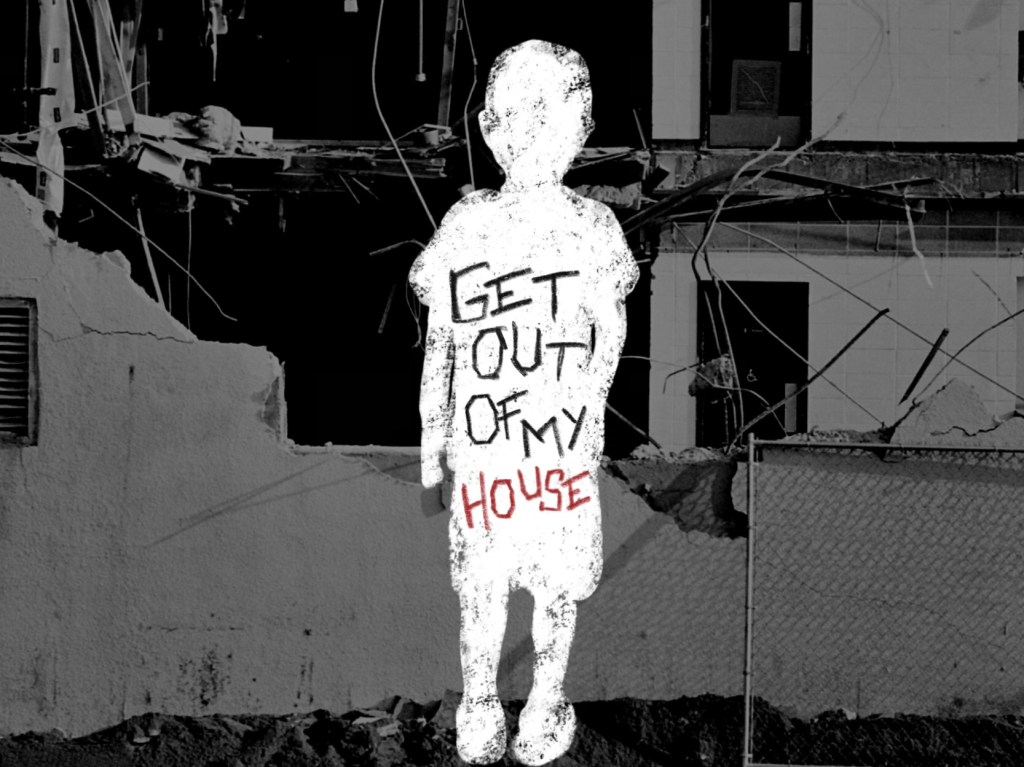
“Get out of my house,” the boy ordered them as he got to his feet.
Outside, a rumbling tank had crushed over cars, lamp posts had been sheared off and trees were chopped in bits. All but one commando slipped past him to search the house, but one stayed and aimed a rifle at Muhammad’s chest.
Muhammad walked toward his rival and kept walking, even as the muzzle of the rifle was pressed onto his chest. Another commando unleashed a military dog wearing a vest and badge like his handler. The Belgian Malinois trotted over, tail wagging. The boy scratched the dog’s ears. Suddenly hands dragged him away and threw him at the feet of Latifa, Reem and Aysha, whom the commandos had rousted from their basement hiding place and pushed against the living room wall. Embedded in cement blocks under atomized plaster, bullets looked like wads of defiantly-emplaced copper-coloured gum.
“Get up, you little shit,” said the commander in Arabic.
The boy did but faced the speaker, whose visored helmet revealed nothing but blue eyes. “If I’m a little shit,” the boy said, “you’re a mountain of waste.”
The commander lifted a hand but stayed still. “How do you know Hebrew?”
“It’s a simple language. Even a seven-year-old can learn it.”
“Smartass. Are there terrorists in the house?”
“Yes. Everywhere you and your friends are standing.”
The Israeli nodded to one of his troops, who stripped the boy naked. His aunt and the sisters averted their eyes. Then the commander bound the boy’s hands with a plastic zip-tie. “Translate,” he ordered. “Don’t twist my words. We’re occupying your house temporarily.”
The boy spoke over his shoulder to Reem and Aysha. Latifa had taught him Hebrew. He used the word rats to describe the Israelis.
“If you don’t interfere, we won’t hurt you.”
More than you already have, the boy thought.
The commander, who knew some Arabic, let it slide. “Go to the basement. You can come up when we leave.”
If you leave, he thought.
Two commandos marched four Gazans downstairs. For an hour, Israeli radios crackled. Israeli voices marked targets and fired. They called in airstrikes and artillery. Muhammad listened and took notes.
Finally, the firing ceased. Nineteen minutes later, the Gazans went upstairs.
The invaders had left a spray-painted six-pointed Star of David on the refrigerator and the destroyed piano. So too, the slogan Price Tag is a play on Julius Caesar’s words, in blood, on a kitchen floor strewn with empty brass casings stamped Israeli Military Industries: We came. We saw. We slaughtered.
The Gazans skated upon rolling metal and fell as if they were slipping over ice.
Latifa was shaken. “Grab your bags. We’re leaving.”
Everyone slipped out and ran down the street except the boy, who ran to find his cat. But it had been shot dead. It was impossible to know by whom.
He heard Latifa shout for him to hurry but never heard the bomb.
✦ ✦ ✦
He did not regain consciousness so much as his awareness of the world came and went. Birds spiralled against a blue background at the end of a tunnel, then disappeared. Later, he coughed up splintered wood, cement dust and something acrid. After a while, bombs rumbled; whether near or far he could not tell. Then he fell asleep.
When he awoke, the open end of the tunnel was star-dotted. He screamed for his mother through cracked, bloody lips. His tongue stuck to the roof of his mouth. Sirens wailed. Guns boomed. Drones whirred. And once again, he fell asleep.
The tunnel was blue and still. After a while, sirens. He tried to move his legs first, then arms, hands, fingers and finally his neck. Nothing. Bricks and wood pinioned him like Nabokov’s butterflies. Prickly heat zinged from his fingers and toes, bursting in his head like fireworks.
Again, he just laid there.
Dark. The world smelled of meat. Searing pain pushed him to the precipice of panic. Have I lost my legs? Or my arms? Adrenaline restored his acuity. How long has it been? He tried and failed to urinate. He cried, but no tears came. His chest burned. Stop being a baby. Auntie will bring help. If she’s alive. Wait. Nothing can kill her. Be brave.
He imagined the foods he would eat when he was rescued, and how they would taste. Omani shuwa, roasted chicken, garlic, almonds and raisins. Couscous with lemon, peas and red chili paste. Strawberry juice. Cinnamon tea. Pistachios. Guava. Pomegranates.
When hunger turned to pain, he imagined the books he would read. Hans Brinker and the Silver Skates. Twenty Thousand Leagues Under the Sea. Dreamed of the oceans he hoped to explore: Pacific, Atlantic, Indian and Arctic. He thought of all the injured that Dr. Jihad could save. He painted mental pictures of the mother and father that he never knew, as well as his uncle and his swimming team. He visualized every breed of dog and played with each on a green grass field he conjured into existence by the force of will. He put on a costume with prosthetic limbs, making him a superhero with the power to destroy enemies of justice and truth. And through all of this, he tried and failed to move.
Light. Muhammad Jihad prayed to God to live. After an extended silence, he prayed for just one more day. After minutes or what felt like years, the sky dissolved from blue to purple.
Now, he prayed to God to let him die. Nothing happened. He wept and imagined himself deep in the ocean at peace, maybe once he opens his eyes that’s just where he’ll be. Still nothing.
Suddenly, from nowhere and nothing, Muhammad heard the grind and roar of what could be a monster. He heard a motor and wheels spinning near the edge of the tunnel. More digging followed as cold gusts of air rushed past him. Then the golden glow of dazzling flashlights and far-off voices called his name.
Weightless, he rose as if he was on an invisible pillar, up through the twilight.
It took nineteen hours for rescue teams to evacuate Muhammad Jihad. He had been entombed for six days—thrice as long as Jesus, said the director of the Seoul-based team, and three days after a halt to the official search for victims. The bomb by kinetic force destroyed the house, but had not hit the boy. Although Muhammad was pinned down, his home had to be removed by a special ordnance disposal team with a hydraulic crane.
On his admission, a triage nurse at Al-Shifa placed Unknown and 19 stickers on his shoulders, signifying that eighteen unidentified pediatric victims had preceded him. The boy had a collapsed lung, head trauma, fractures, lacerations, hypothermia and dehydration. The Berlin-trained trauma surgeon told Latifa that, although the tunnel the bomb had created in her house provided some oxygen, given the extent of the boy’s injuries and how long it took to reach him, nearly everyone—except one in a million—would have died.
What had saved Muhammad Jihad’s life was sheer determination to live.
And of course, added the spiritually uncertain Latifa Jihad, the will of God.
Muhammad Jihad rose from his bed in three days, ready to continue the struggle through all of its manifestations.
 Riadh Magazine
Leave a comment