By Hadiqah Khalil
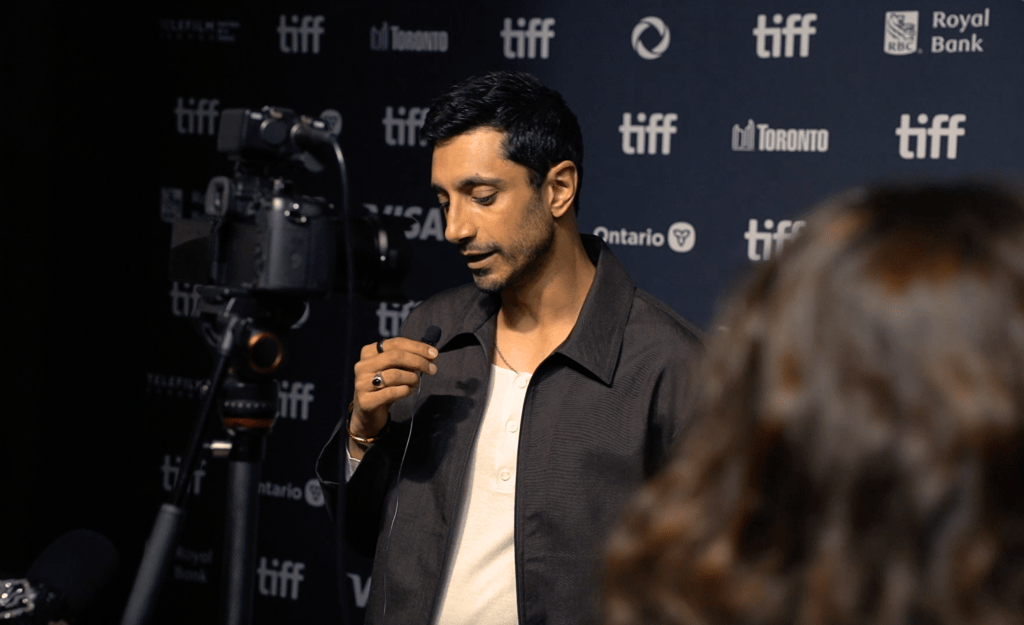
“A lot of us are feeling like we’re grieving the way that we thought the world worked, and we’re being confronted with how it really works,” said Riz Ahmed at the Hamlet premiere at the 50th Toronto International Film Festival (TIFF).
In that moment, it felt like the world—the one that so often seems unreachable through our phones—did not feel so far away after all. There are people with a voice and privilege who are just waiting to be asked about a topic that sits just as deeply in their hearts. But beyond being asked, these stories of minorities, displacement and resistance are being told in a space that commonly feels like we could lose everything, just by mentioning the name of a city that sits at the edge of every media headline right now.
There are so many versions of Hamlet circulating in culture at the moment, and Ahmed gave space for that in our brief, three-minute conversation—a space where I questioned if my role as a journalist is to feed into the culture of idolization or to leave room for artists to simply tell their stories.
So the famous Shakespearean quote arises: to be or not to be. To be intentional and vulnerable. Or not to be just another chronically online person chasing soundbites, outside of what is real.
The streets of Toronto were loud. Film fiends would call it passion. Fans who are unapologetically themselves chanted through the streets over their favourite star, jumping for joy at the call of their name, standing in the TIFF rush line for hours for even the slightest chance at a screening ticket.
I rushed past the lively group of film lovers as they crowded the corner of King Street West and John Street. I ran into the TIFF Lightbox with my press pass in one hand and my phone in the other. My hijab was wrapped over my ears and tucked under my chin, sheltering me from the chilly 22-degree Toronto air—but in the overstimulation of it all, I did not adjust it. I left it. The mic I rented from campus was hanging halfway out of my tote bag’s unzipped latch. I left it. The email confirming I had been accepted to interview on the carpet of Ahmed’s Hamlet came an hour too late. So, my university class? I also left it. I left it all behind because I was stepping into a world of entertainment that I barely recognized, unsure of the kind of journalist I might become on the other side of it.
I entered the building, welcomed by a warm gust of air as it carried behind me the voices of cheering fans. The dichotomy of it all suddenly hit me, knowing that this silence—this silence is a special kind of intention. We journalists were there to make it somewhere—beyond the physical space we stood in. And the stars behind the black screen lining the red carpet? They were at a press premiere where their image often outlives the art itself.
So I get placed in a spot, and number six is written on a piece of paper below my feet. I scurried through my bag of rented equipment, only to realize the mic I had lugged across three subway stops (as if it were my ticket in) would refuse to turn on. I do not have a professional camera, I no longer have something to capture audio with, and what kept echoing in my head was how I somehow started this magazine that I do not know how to lead—out of fear from people not wanting to read what I have to say. Maybe they would scroll past unless it is something like “Jeremiah or Conrad”. If we are talking about the political state of the world, I would say Belly needs to leave them all and find who she wants to be—but there was something deeper I came here to uncover.
After a few photos of the Hamlet cast striking poses in glitz and glamour, Ahmed finally appeared on the carpet. It was refreshing to see the man I had seen only through my screen standing just ten feet away. Dressed in a deep brown bomber jacket with matching pants, Ahmed appeared to be an approachable guy in a room which carried a light energy.
I wonder if these stars talk to themselves in the mirror, repeating the same answers over and over? Do they believe their own words?
Most of the time, I am just trying to make it somewhere—reminding myself that it is okay to shine quietly, without the desire to be known. But then I think about someone like Riz Ahmed.
Can he shine lightly, with depth and authenticity, if we—the media and audience—do not give him that space? Or are we all waiting for him to perform the version of a Western actor that feels familiar and safe?
Because the truth is, I am not just asking this about him. I am asking about myself. Is wanting to be known a reflection of ego, or is it the hope that our voice might change the perception of things, perhaps even move hearts?
And then Ahmed and Aneil Karia, director of Hamlet, had a conversation with me, and none of those thoughts mattered.
They were not reciting. They were there. Present, passionate and real. I could see it in their speech that no matter how many times they repeated similar thoughts to those ahead of me, they believed in this film.
I will no longer pretend that this does not mean anything to me—my job as a journalist. Me standing on this carpet, nowhere near the social platform that these stars are standing in front of me are on. But it means that I get to reshape the narrative. So I dropped the script in my head, I stopped chasing the perfect question and asked what I wanted to know:
What does it really feel like to be seen?
“We have different sides to ourselves. I think sometimes we do that in public, or sometimes you need to protect yourself and put on that mask,” Ahmed responded. “And sometimes you feel like, well, actually, no, I just want to be myself in an uneducated way. And I think that changes from day to day and from person to person that you speak to honestly.”
Hamlet is a reimagining of Shakespeare’s famous play, set in a world where privilege and desperation collide—now grounded in London’s South Asian community.
Ahmed explained that what makes a story like Hamlet timeless is that it always finds a way to feel timely.
“Hamlet feels how the world is so messed up right now. Am I losing my mind, or has the world gone crazy? I can’t work out which it is. Am I the only one who’s not seeing this? So it’s that kind of trippy headspace [Hamlet’s] in where he feels hopeless, powerless and gaslit about the crazy things going on,” he said.
I told Ahmed how much leaving space for Palestine meant in a room like this. He did not flinch from naming what others find hard to name. In a room full of unknown convictions, he left space for the red hiding beneath the carpet.
“I think that’s resonating with a lot of people right now,” Ahmed said. “That’s why so many [people] want to explore this play again. There’s something in [Hamlet] that feels present. But there’s also healing in it. And I think it’s a reminder—that alongside the hardship and struggle, we have to hold on to the beauty in all of us.”
So that is just what I held on to. I did not know what it would be like coming into a place like this. Some rooms ask for performance, and some others make space for presence. And the lingering thought which felt unresolved: to be or not to be.
To be in a room with others who look like you, who make time for you, does not feel so alienating after all. To be does not have to come from the desire of visibility, but from the need to be heard and understood.
Ahmed did not show up just to be seen. He showed up to leave space for the rest of us.

 Riadh Magazine
Leave a comment