By Raghad Genina
“If I must die, I want a resonant death. I want to be neither a newsflash, nor a number within a group. I want a death heard by the whole world, an impact imprinted forever, and everlasting photos that won’t be buried by time or place,” said Fatma Hassouna.
I settle into my seat in the theatre, eager to watch the film I have heard so much about. That feeling suddenly fades the moment I remember what exactly it is I am watching. As the film begins, the theatre lights start to dim and the screen turns pitch black for a few moments. Confused—I look around the theatre, wondering when the film is going to begin. Trying to see if others are feeling what I’m feeling—the silence in which the darkness carries. That is, until I hear what sounds like bombs going off around me. My heart rate spikes and anxiety rises with every explosion I hear. I see nothing but shadow, and hear only the sound of explosions and distant screams. Just as I start to panic, the film flickers to Fatma Hassouna’s face.
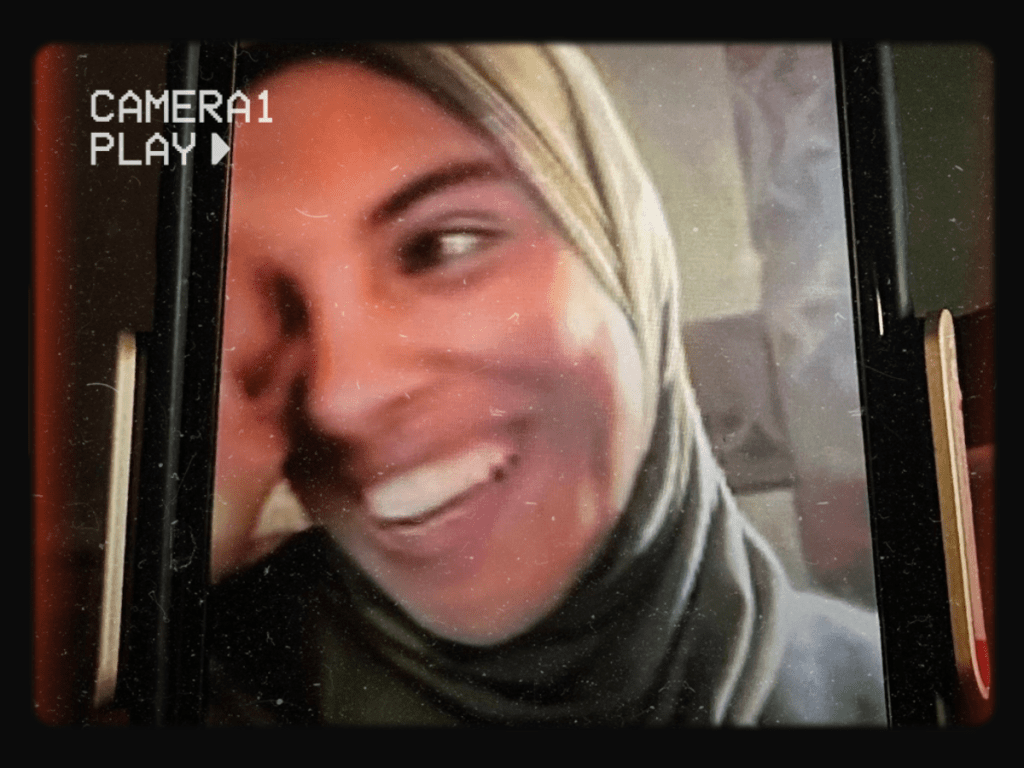
Put Your Soul on Your Hand and Walk, screened at the 50th Toronto International Film Festival, follows photojournalist Hassouna’s life in Gaza through a series of phone calls with the director, Sepideh Farsi. Throughout the film, the viewers meet Hassouna and her family as she discusses life in Gaza since Oct. 7, 2023.
I feel the weight of my privilege weighing down on me. I witness life through the lens of Hassouna and her love for photography. The way she captures her world. The rubble that surrounds each home she flees to. Yet here I am, in the comfort of my seat, in a room with heating, surrounded by hundreds of others like me breathing, watching and embracing the pain of a girl through a cinema screen. At any given moment, I could leave the theatre if I feel uncomfortable or afraid. Meanwhile, Hassouna can’t walk away from her reality. She doesn’t get to watch from a safe distance; she’s living it. As viewers, we see a glimpse into the unbelievable, while the people on our screens are forced to endure it day after day.
Hassouna documented and photographed life in Gaza. Despite the danger, she put her soul on her hands and walked to capture the truth. Straight into the unknown, unsure of whether she’ll be the next in her family to die. She tells us about her life. About the famine, the sleepless nights, waking up to the sound of bombs, and news of the people closest to her being killed. She says it all with a smile on her face, a smile that never faltered. Although she had endured so much and at times described feeling like her brain was deteriorating, she never failed to remain hopeful, even when recalling traumatic events.
“The people of Gaza have many options to die. People here die from bombing, fear or starvation,” said Hassouna.
For the last 707 days, we have watched the death toll in Gaza rise; these deaths are reduced to numbers on our phones. This film humanizes the people of Gaza. It doesn’t just tell us about Hassouna’s story but brings it to life through her videos, photographs, and the video calls that we get to witness—as if we were in the room with Farsi. For a brief moment in that dark theatre, the audience wasn’t looking at statistics, but the lives lost and the countless others enduring this terrible reality.
Hassouna had a dream—a dream to travel. To visit Rome, to go to amusement parks and to photograph the world. She held onto the hope that one day she would live out her dreams, but as she said in the film, “Hope is a very dangerous thing to have.”
As the film came to an end, we saw Hassouna’s conversation with Farsi one final time after she heard news that Put Your Soul on Your Hand and Walk was selected for its first screening at the Cannes Film Festival. Hassouna and Farsi were making plans to get her out of Gaza so she could watch the documentary with her own eyes.
Then it all goes black. Subtitles appear on the screen revealing that Hassouna and nearly her whole family were assassinated soon after the film’s screening at Cannes was announced. The theatre falls silent. I shift in my seat, shocked at the truth. The audience grew to love Hassouna and find comfort in her smile. Many of us are shaken by the news of her death. I’m still frozen where I’m sat, struggling to process what I’ve just read. Hassouna’s death is not an isolated incident; we have heard of many like it. It’s a reality of life in Gaza. Her story echoes the lives of many journalists in Gaza who risk everything to document the truth. Put Your Soul on Your Hand and Walk is more than just a film; it’s a living memorial that preserves Hassouna’s life, her voice, her courage and her smile.

 Riadh Magazine
Leave a comment