By Dania Daud
I first started watching Saleh al-Jafarawi back in 2023, when I was just beginning to see journalism not only as something I liked, but as something I could pursue. His videos appeared on my Instagram feed—raw and unfiltered. I found myself watching him to stay updated on the genocide unfolding in Palestine. But as I kept watching, something changed: his work revealed the power of voice, the weight of responsibility and the courage it takes to speak the truth in the face of danger.
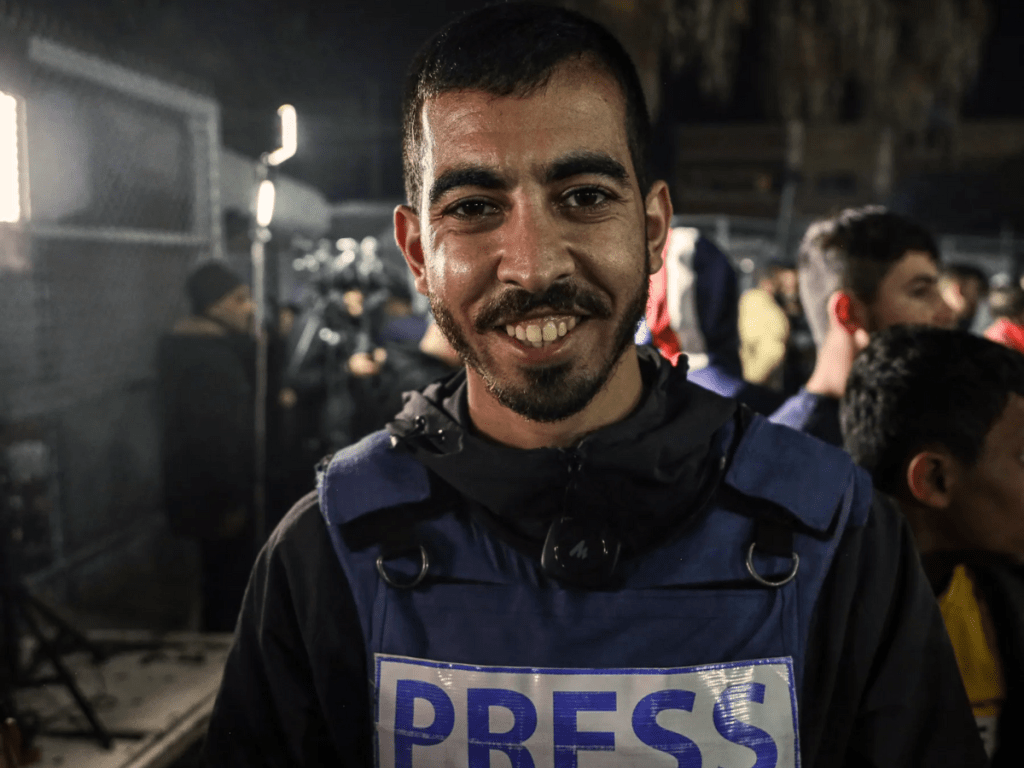
Al-Jafarawi was a young journalist from Gaza City, holding a camera and recording life under siege. Sometimes he filmed from rooftops, other times he moved through streets that had already been destroyed. He studied at the Islamic University of Gaza, but his classroom became the streets themselves, and his lessons were learned in real time. His reporting on the genocide, which gained popularity in late 2023, earned him praise. His lens captured the people living through the chaos—their fear, their resilience, their determination to keep going.
Millions followed him, yet he never performed for an audience. Each clip, each post, carried the urgency of a witness statement. Al-Jafarawi ensured the world saw the stories that many couldn’t tell themselves.
Seeing him report in real time, putting himself in danger to show the truth, inspired me and made me realize that journalism could be my way of making voices heard. The streets he moved through were dangerous and unpredictable, but he went where the story demanded.
He showed the world that nothing about telling the truth is easy. Most of all, he showed us that the cost of silence is higher than the cost of fear. Sometimes people won’t speak up for you, but as a journalist, you can speak up for yourself and others through you. You can reveal what the world might not want to see. At times, the truth can put you in danger, but it is always worth it.
His connection with the people he filmed and with the viewers following him across the world was undeniable. His reporting during the genocide was about being a witness. Every story captured a life, a moment, a truth that might have disappeared. He moved through chaos with intention, wearing a vest marked “PRESS,” pointing his camera where others would turn away from.
Then, on Oct. 12, 2025, Saleh-al-Jafarawi was killed. He was shot while covering clashes in Gaza, the same place he had risked so much to show the world. The news of his murder shocked me. For a moment, it felt impossible to comprehend that someone so committed to the truth was gone. But beyond the shock, I found myself reflecting on the life he had lived. He documented footage in a place where destruction was constant, where fear never eased and where witnessing violence firsthand could be deadly.
What struck me most about him was how openly he acknowledged fear alongside courage. Al-Jafarawi said:
Honestly, I lived in fear for every second…I was living life second to second, not knowing what the next second would bring.
Rarely do you see someone admitting that so honestly. And maybe, that’s why I felt connected to his story. I was a teenager, writing articles and gathering quotes, thinking about journalism from the safety of my classroom while he was in Gaza, doing the opposite: risking everything so others’ voices could be heard.
Al-Jafarawi’s work taught me the responsibility that comes with journalism. Seeing the hidden, the overlooked, the dangerous and telling those stories means confronting fear and carrying truth that others may not want to face. It made me ask myself: if someone else can risk their life to show the hidden truth, what am I willing to risk to tell the stories that matter?
Journalism isn’t always glamorous or easy. It’s messy, it’s exhausting and sometimes sacrificial. But it’s also essential. To remain silent, especially when injustice is unfolding, is to choose to look away.
In the days after his death, I kept thinking about what it meant to dedicate your life to something far larger than yourself. Even from a distance, I could take pieces of that courage into my own work. He made me question my own limits—how far would I go to uncover the truth? How do I keep writing when the world would rather stay silent? And maybe most of all, what stories are we leaving untold when we stop paying attention?
Al-Jafarawi lived through and documented what most of us could never imagine. He made choices that demanded both courage and sacrifice, reminding the world that to see, and to make others see, is itself an act of resistance. His death is a call to watch, to report, to care.
Saleh Al-Jafarawi was the voice we lost. Every time I sit down to write, every time I notice a story no one else seems to see, I remember the risks he took. He showed me that journalism means standing in the middle of chaos and refusing to look away. To give people a voice is to fight silence; to bear witness is to defy forgetting. Even the smallest act of noticing can matter more than we realize. He left behind a challenge for all of us: to become the voices that remain, and to carry truth forward, even when it feels impossible.
 Riadh Magazine
Leave a comment