By Grace Henkel
When Elma Brakic joined a pro-Palestinian encampment on the Western University campus back in the spring of 2024, she stood alongside dozens of other student activists every day for its entire two month duration.
But during that period, something made her feel very alone.
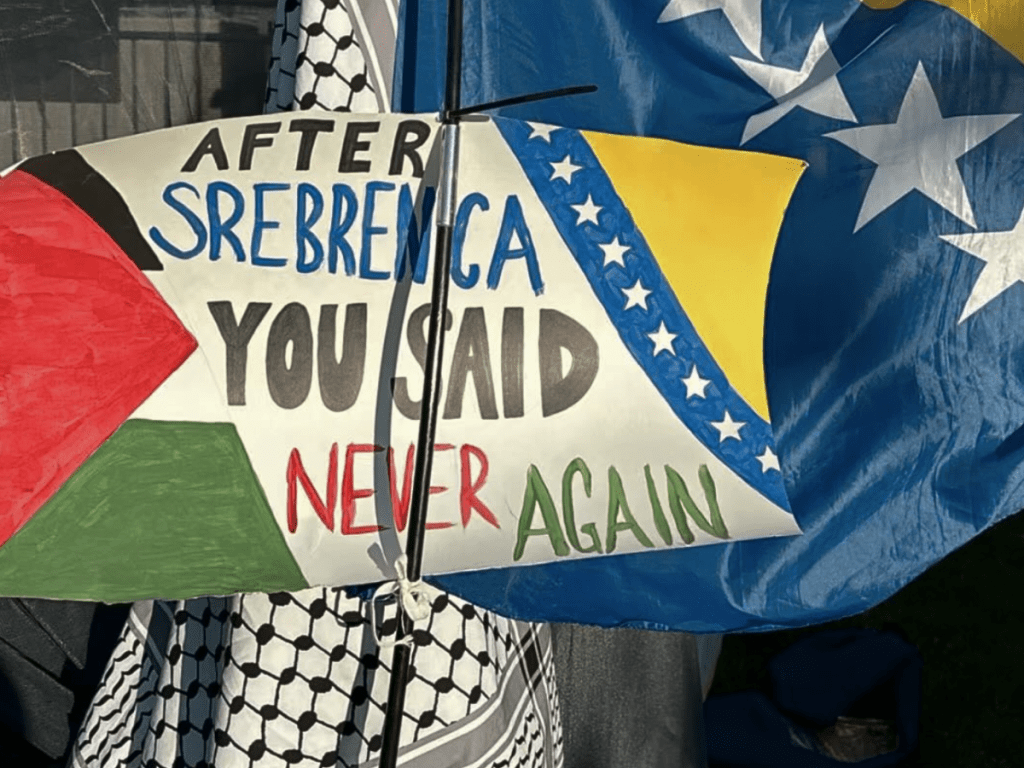
To her knowledge, she was the only Bosnian Canadian student to join the Western Divestment Coalition. The student-run coalition called on the university to divest from military contractors and other corporations linked to Israeli settlements in occupied Palestinian territory.
The coalition demanded Western cut ties with any companies “complicit or actively participating in the occupation, apartheid system, and current genocide of Palestine and Palestinians,” as stated in the group’s official proposal at the time.
Brakic is the daughter of refugees who fled to Canada from Bosnia in the late 1990s during the collapse of Yugoslavia. Under then-President of Serbia, Slobodan Milošević, Bosnian Serb forces carried out systemic acts of ethnic cleansing, sexual violence, and genocide against Bosniaks, or Bosnian Muslims. Last summer marked the 30 year anniversary of the Srebrenica genocide, where over 8,000 Bosniak men and boys were slaughtered. It was the worst act of mass killing in Europe since the Second World War.
What Brakic’s parents and members of her community went through is still raw. She says the traumatic effects of that genocide continue to reverberate through younger generations in diaspora. When Israel launched a ground invasion in Gaza following the events of Oct. 7, 2023, the destruction of mosques, acts of collective punishment, and killing and displacement of civilians brought it all back. She felt a deep sense of responsibility to speak out.
“Seeing the exact same thing that I studied my whole life, that I knew happened to my own people and my own family, seeing it happen again–it just triggered something,” she said.
For Brakic, the absence of other Bosnian Canadians at the Western encampment stung. She made a speech at the 29 year Srebrenica memorial in Windsor, Ont., not long after the Western Divestment Coalition ended their encampment.
Brakic recalled addressing her peers from the community. “I was kind of like, ‘Where were you? Like why weren’t you guys here?”
“This is the time to show up because if our martyrs mean anything, you have to stop it from happening to somebody else, you can’t just sit back and watch.”
Ramadan–the ninth and holiest month of the Islamic calendar and a period of fasting, charity and reflection for Muslims worldwide–has been an especially poignant time for Bosnian-Palestinian solidarity.
Despite a “ceasefire” agreement in October 2025, Palestinians observing Ramadan this year in Gaza are still feeling the lasting impacts of forced displacement, widespread hunger due to Israel’s restriction of humanitarian aid, and the loss of their family members–as previously reported by Al Jazeera.
“Everyone is yearning for their community during this month–everyone wants to be together,” said Brakic.
Emina Kapo is the general director of the Bosnian Canadian Association, a youth-led organization based in Ontario that is dedicated to building community for Bosnians in diaspora.
For her family, the breaking of their daily fast is always done with the Palestinian people in mind.
“Every single day when we sit down for Iftar, we don’t eat before we remember them, before we say a prayer for them,” she said. Kapo was particularly frustrated with previous restrictions on the passage of humanitarian aid into Gaza, and the still “insufficient flow” of aid entering Gaza reported by the United Nations in March 2026.
Often, for her and her family, she says: “The strongest thing we have as far as solidarity is our prayers.”
Kapo was born in Bosnia in 1993, in the midst of the genocide. Her parents, both in their 20s at the time, emigrated to Canada when she was young. She describes their survival and the life they later built in Canada as “a miracle of God.”
“When everything started up again in Palestine [in October 2023], my Dad couldn’t turn on the TV,” said Kapo. “He wanted to, but he couldn’t. He didn’t need to see any of it to feel what was happening.”
Kapo teaches Sunday school sessions at a Bosnian masjid in Hamilton, Ont., the same mosque she grew up attending. She also runs an after school program at a private Islamic school in Hamilton, and many of her young students are from Palestinian diasporic communities.
She’s witnessed Palestinian students and their parents navigate grief, strained communication with relatives, and so many unknowns over the past few years.
“I’ve really kind of just walked through this with them,” said Kapo. “I see them every single day. And it’s not just the kids either, the parents, they’re like, “When we were growing up, we knew about Bosnia,” and so we had that connection.”
“Their strength and courage and hope that they hold on to despite everything is out of this world.”
“We always say never forgive, never forget, and never again to anyone again, but it’s happening in front of our eyes,” said Kapo. “I know that our solidarity and our standing up means so much because [Bosnians] understand a lot better than most people with that lived experience.”
Despite being frustrated by the initial absence of her peers at encampment protests, Brakic feels hopeful. Enduring trauma, she says, means it’s common for members of her community to remain silent about their experiences. Over the past few years, she has witnessed many Bosnian Canadians share stories that they had never felt strong enough to speak out about before.
“I feel like we’re finally looking at all of us as one Ummah,” she said.
“We’re one people, we’re all one at the end of the day and we need to be united, we need to be together no matter what and we need to fight for each other.”
 Riadh Magazine
Leave a comment